• Skip to main content
  • Skip to primary sidebar
  • About This Website
    • A polite reminder
  • How To
    • Use this website and benefit from the subscription option
    • Pick a financial adviser
    • Ensure your investment adviser is delivering good value
    • Get expert help with running your own portfolio
    • Pick a ‘tax wrapper’
    • Pick a Trading Platform
    • Diversify a portfolio in today’s world
    • Invest in line with your conscience
    • Research (screen for) a specific fund requirement (m)
    • Pick a fund for the future or how to be a contrarian (m)
    • Find the ‘next best thing’ and make rational sell decisions (fund switching) (m)
    • Time investment sales (skim profits) (m)
    • Interpret a Morningstar X-Ray (m)
    • Use Trustnet for Research (m)
    • How to review a neglected portfolio when the world has moved on (m)
  • *Important Information*
  • Real World
    • A Frank Introduction to Investing
    • Costs
    • Investment Risk – Your Starter For 10
    • How are advisers fees worked out?
    • 10+ top tips for investors
    • An actual portfolio review (m)
    • Benchmarks – a thorny subject
    • Disinvestment from fossil fuel businesses – are there better options?
  • Tales of the Unexpected
    • Lola
    • Round and Round the Mulberry Bush
    • FOMO (Fear of Missing Out) and the lazy mind.
    • Property Development Schemes
  • For More Experienced Investors
  • Glossary with a Difference
  • Member Only Content (M)
    • Example of simple cash flow planner (m)
    • Long Reads
      • What is market shorting and is it a bad thing?
      • How to conduct a periodic portfolio review (m)
      • Investing without management (passively) – a better way? (m)
  • Portfolios and Funds (m)
    • Lessons in Portfolio Construction and Maintenance – Introduction
      • High Level Asset Allocation
      • Selecting Funds
      • Cash Flow and Tax Issues in Portfolio Construction
      • Setting Objectives and Understanding Risks
      • A suggested portfolio for Alex Bright
  • Multi Asset Academy (m)
    • Some basic basics
    • Who are Vanguard?
    • Are multi-asset funds expensive?
    • Cheap and cheerful?
    • Its all about asset allocation, but…
    • Myth and misunderstandings
    • Taking money out of multi asset funds – the pros and cons
    • Distribution funds – the forerunner of multi asset investing?
    • DIY Multi Asset – adding risk controls
    • Benchmark Fog
  • Member Login
  • Logout

Its Not Harry

Comment and opinion for retail investors in the UK

Economics

Midweek Musings – New direction?

13th December 2023 by Mark Potter Leave a Comment

As I have repeated ‘ad nauseum’ the likely direction of both equity and fixed income valuations has for many months depended only only one factor: what markets though would be the next central bank move on interest rates.

Different market segments have reacted in slightly different ways, such as short dated bonds doing better than long dated when rate rises were frequent, but really the alleged ‘fight against inflation’ has been the only news you needed to follow.

I think that will change in 2024.
You need to be logged in to view the rest of the content. Please Log In. Not a Member? Join Us

Filed Under: Economics, Markets, Members Only, Monthly commentary

Midweek Musings – no correlation?

6th December 2023 by Mark Potter Leave a Comment

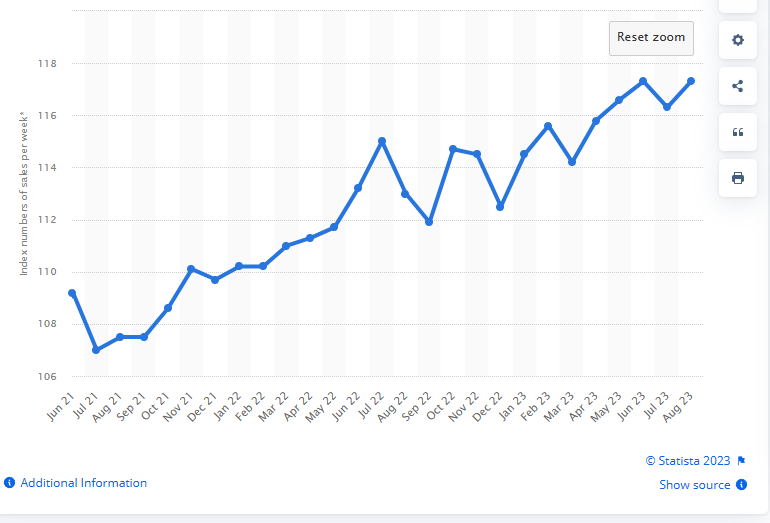
Take a look at this chart:

The above is one measure of retail sales growth in Great Britain (Source: Statista).

You need to be logged in to view the rest of the content. Please Log In. Not a Member? Join Us

Filed Under: Economics, Markets, Members Only, Monthly commentary, Rants

Midweek Musings – China goes all Thatchery?

17th October 2023 by Mark Potter Leave a Comment

It was nearly 40 years ago…

Remember Sid? That was name of the mythical person who was going to be told by the whole newspaper reading/ ITV watching population of the UK to buy British Gas shares. This was the second big privatisation (after BT) in an era of mass privatisation by Mrs Thatcher’s Conservative government. The general idea was to get the public at large into share ownership as a way of making money over the long term (a sound idea, with qualifications, of course) and maybe feel a little bit fonder of capitalism.

It would surprise no-one that a Conservative government in a free market economy would encourage wider share ownership amongst the public.

China wants more micro capitalists

What astonished me was a quotation I heard yesterday from a senior official in the financial system in the world’s largest Communist state with a wholly state controlled economy saying, in essence, that the goverment needed to set up a fund to buy shares in the Chinese stock market, so that valautions were propped up and citizen share holders would feel better off and go back to the desired level of consumption!

I am forever being surprised by what people with too much power come up with – not in nice way.

Actually, I have learned that this is not the first time that the communist government of China has supported its equity market and on both previous occasions, it all ended in tears. The same could well be likely this time as the government running a fund that owns significant holdings in important companies, even if it not actually nationalisation by the back door, would turn other investors into co-investors with a large, ethics free and powerful shareholder capable of all sorts of undesireable behaviour. Pump and dump immediately comes to mind, even if it might be an accidental process.

Why?

The answer is that if consumption is the cocaine of capitalism, as I frequently say, then it appears it is the crystal meth of state led economic growth. or even Communism. Stalin many have failed to pick up on that.

The Chinese economy has not returned to rapid growth after coming out of the zero Covid lockdown period and that is thought to be partly because the Chinese consumer is nervous. In emerging economies (like where I live) the first asset class people fall in love with is real estate. It is tangible, you maybe want to live in it, and when economies are growing, it goes up in value most of the time. If Marx thought property was theft, then post Marx, let’s all be on the winning side!

However, the Chinese real estate market is currently something of a car crash. A good proportion of bonds (fixed income assets) are linked via the financial sector to the property market, so they look risky too. So it is perhaps logical that the state wants people to move on to owning that harder to understand and more volatile asset class, equity shares. But those pesky overseas institutions are having a big downer on China , because the economic good times have not returned as hoped for! What to do?

Options

Basic economic theory tells us that growth in GDP comes from 3 main sources: consumption, investment and government spending. The last is one to argue about, because if government spending was ‘honest’ it would be funded by taxation and that would be a depressor of growth. Generally, it is funded mainly by borrowing.

Exports and international trade are other factors but I won’t go into that here.

Consumer spending has an obvious sustainability impact. We all over consume because since the 1920’s there has been in place a massive machinery designed to make us feel happy doing just that.

Investment can have varying impacts.

Building a new fast railway line to Manchester has some environmental negatives in the building stage, but likely has considerable positives in reduced car journeys etc. I am no expert on the HS2 project but no doubt a lot of work was done on the sustainability implications of the project.

Investing in low cost housing, green energy, research and innovation facilities and so on adds to economic growth with probable social benefits too, but these are poorly accounted for in the rather crude calculations of economists.

Government spending can be both investment and/or consumption. Unfortunately much of it is poorly managed inefficient consumption and indeed, even in supposedly well regulated developed economies, a percentage of government spending is filtered off by corruption. You could argue that crime is economic activity, but few would encourage a rapid expansion of that sector!

And in China

It is well known that in China they certainly do the goverment spending, both nationally and at regional level, even if it may be disguised through intermediate financial structures. They have massive international debts to prove it!

Investment has been strong too and best of all, it was until recently coming into the country from overseas. That is the ‘gold standard’ primer of growth. But political decisions have scared off some international investors. As I write, Tim Cook of Apple is reported to be in China, so maybe all is not lost, but it needs to be born in mind that Hauwei have taken a serious swipe at Apple’s local market share, so maybe he is more interested in sales than production.

Maybe boosting consumption is the only policy lever left to pull and maybe a sort of reverse Thatchersim is worth trying – the government buying shares, not selling them, to boost the wealth of citizens and make them want to spend freely.

Increased Chinese spending would be good for investors like us, especially if we own funds invested in global brands and luxury goods, or firms that make money from global travel. However, my quick take on the reported proposal is that it is far from well thought out!

Filed Under: Economics, Members Only, Monthly commentary, Politics

Midweek Musing – Morningstar on Europe

11th October 2023 by Mark Potter 2 Comments

Having heard what Morningstar’s (MS) US experts think about US markets and reported that to you, I have since watched the equivalent webinar for Europe. Note that when we talk about European stocks we usually mean ex UK, whereas MS will be referring to their EMEA regional definition which includes the UK. It was notable how much less bullish the tone was overall!

You need to be logged in to view the rest of the content. Please Log In. Not a Member? Join Us

Filed Under: Economics, Markets, Members Only, Monthly commentary

Watching Brief – October 2023

6th October 2023 by Mark Potter 2 Comments

Pottering About

As the section heading suggests, this month’s commentary is going to be something of a pot pourri of news and comment.

I hope at least one or two snippets will help my readership to better understand what is happening in markers, what that signifies and how to make any minor course adjustment in your portfolio planning journey. 

You need to be logged in to view the rest of the content. Please Log In. Not a Member? Join Us

Filed Under: Economics, Markets, Members Only, Monthly commentary, Portfolios

Midweek Musings – lies, damn lies and Irish data

23rd August 2023 by Mark Potter Leave a Comment

It has for a long time seemed bizarre to me that investment markets react to data published by assorted goverment and private statistical organisations as if it was gospel truth. Market valuations across the globe will vary by trillions on a daily basis just because a number comes in ahead or below some sort of expectation – even when that expection is no more than a few telephone calls cobbled together to generate an average prediction by the likes of Reuters or the FT. What’s more the data that moves markets is quite often corrected later and interestingly, the corrections receive little passing comment and rarely move markets!

What data can you believe? Does in even matter?

This is yet another of the human behaviourial aspects of short term market valuations that investors need to understand so that we do not get overly worried about the random hazards of transaction timing and short term portfolio valuation swings.

A headline in today’s FT intrigued me. I can’t see the full article because I am not an FT subscriber, but the implication is that the fact that many large Americam corporations use accountancy tricks to re-allocate revenue, including that generated in the UK, through the Dublin financial centre (a sort of freeport) is resulting in inflation of EU data on corporate incomes. I suppose that may even count in the GDP calculations – I don’t actually know.

The technical details of what is happeneing don’t really matter. What this brings to our attention is the fact that economists and investment strategists (a sort of ‘astrologist’ that some investment houses employ!) often make predictions based on data that is collected unscientifically, is too narrow in range, is not actually the data relating to the economic factor being assessed or is just educated guess work, or even just a reuse of a ‘concensus’ number.

I saw some charts yesterday showing the predictions of all the major global banks about this year’s growth in the Chinese economy. They were laughable, even though they were no doubt produced by teams of people who were collectively earning many millions in salary. The numbers centred around what the Chinese government itself predicts (free data) and went up or down over the last 12 months according to news coming out of China. That is about as clever as me saying the car is slowing down because my foot is on the brake pedal, or we will be going faster soon because I pressed hard on the accelarator!

The long term value of shares will always revert to the actual valuation of cash flows (ie profits and dividends). Short term valuations are the result of speculation and algorithmic trading and importantly human reactions to news flow which sometimes is based on the flimsiest of factual or pseudo factual reasoning.

We can benefit from this understanding by working out what the market does not want to acknowledge is good value because the data thought to relate to the assets in question is simply misunderstood or inaccurate. At the moment, there are shares in the UK that fall in that opportunity set.

Filed Under: Economics, Markets, Monthly commentary, Portfolios

  • « Go to Previous Page
  • Page 1
  • Interim pages omitted …
  • Page 4
  • Page 5
  • Page 6
  • Page 7
  • Page 8
  • Interim pages omitted …
  • Page 16
  • Go to Next Page »

Primary Sidebar

Recent Posts

  • Mid-month Musings – September 2026
  • Deep Dive – September 2026
  • Mid Month Musings with Mark (not me!)
  • Thank You
  • Deep Dive – August 2026

Archives

Categories

  • Academic theory
  • Announcements
  • Asset Allocation
  • Basics
  • Cost of investing
  • Economics
  • Education
  • Funds
  • House rules
  • Humour
  • Innovation
  • Markets
  • Members Only
  • Monthly commentary
  • News
  • Opinion
  • Passives and Trackers
  • Politics
  • Portfolios
  • Rants
  • Research tools
  • Site Content
  • Sustainability/ESG
  • Trading
  • Uncategorised