The heading is a horse racing reference. We are now one month into 2023 and it is possible to see how the runners and riders are positioned at the first hurdle/bend in the track.
You will recall that I have so far this year pointed out that we started the year without a clear case for adopting either a positive or negative attitude to equity markets; that fixed income funds with longer duration looked like a no brainer, and that the case for returning to China for equity growth was being made without wholly convincing me.
Some market data
This chart is courtesy of one of my subscribers, Eugene. It suggests that all the main equity markets had a decent start to the year but that China has really flown since November 2022 – the end of the Covid lockdowns. The US (in Sterling terms) was the least profitable place to be invested. Note carefully the relatively short time period when thinking about this data. Also note that the UK All Companies sector will not reflect performance of UK value or contrarian funds over the last year or two.
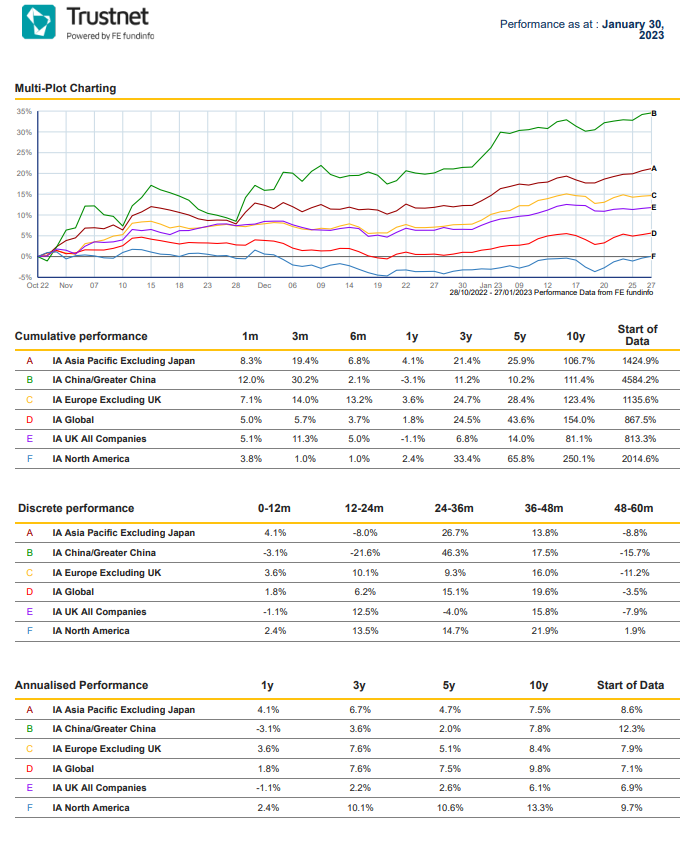
At the time I saw this chart, I also received an opinion piece from Peter Hargreaves, now Chairman of Blue Whale, making a strong case for the relatively secure North American market. In terms of geo-political risk, he makes good sense. The outlook for the dollar is rather more uncertain, given the high levels of US government debt and the fact that we are already started into the first phases of the next US election cycle (given the age of the main potential candidates, an early start may be advisable).
As I write today, we are about to bump into the next set of interest rate decisions by the main central banks and some US employment data will become available this week as well. The concensus is that although there is some evidence for a softer landing than the full on recessions predicted a few months back, central banks may see this as a reason to hesitate before offering some stimulus in the shape of stalled out interest rate rises and even reductions.
It is clear that both the equity and fixed income markets are already focused on the next part of the cycle, when inflation has come down and governments want investment and growth. Investment has been neglected by the main players in the capitalist markets for some time, with the reliance on consumption and the enthusiasm for allocating wealth to shareholders as fast as possible, even when there are no profits to justify it!
The political climate has also not served to make capital re-investment attractive in many industries and regions and the developing countries, including China, have been the areas where real money has gone into building industrial bases, for example, in battery production for electric vehicles. Expect developed market governments to focus on this deficit now – the Biden administration is already doing that and I would hope the Messrs. Sunak and Hunt take note.
That’s all waffle – get to the point!
I would imagine you might be thinking the above if you have read this far!
What is my personal call on the basis of current facts?

I am duty bound to point out that strategic asset allocation is about the long term and diversity is the foundation of risk management, so the news in 2023 is not likely to be that useful in designing a new portfolio, nor should it prompt a portfolio overhaul!
The most existing portfolio holders should be looking to do is to make tactical changes.
Having said that, I am currently thinking:
- Fixed income funds with long duration can have a place in my portfolio after a few years absence. They will in the main replace holdings in gold (even though gold has itself has a good run in 2023 so far) and some absolute return and macro strategy holdings.
- I will reduce my UK equity weightings to take profits and possibly rebuild my underweight exposure to the Asia Pacific region. I accept with some reservations the argument that the Chinese consumer is now out and about with money to spend!
- I think interest rates in Europe are behind the curve so will reach the point of topping out later than in the US and the UK, so the Euro may be the currency to own. However, because I earn Pounds and spend Euros, I have needed to hedge the risk of Sterling weakness for a long time, so personally have a very heavy overweight in Euro denominated assets anyway. Others may want to increase their European fund holdings.
- Two asset classes that are best avoided for now, in my judgement, are real estate (for multiple reasons) and cash (which is being rapidly deflated by ultra negative real interest rates). I have no property at all in my asset base (not even a private house!) and only the minimum cash to provide a secure income in the event of a setback.
None of the above is a recommendation for anyone else, but I hope comparing my thoughts to your own will assist your decision making. I welcome questions from subscribers, of course. My monthly commentary will be published soon.
You must be logged in to post a comment.