If you are like me, you will have spent Easter mostly at home with maybe a short trip or two to the supermarket or a walk or bike ride, (with a mask on?) for permitted exercise. In the meantime, stock markets have been closed and the tone of the news about the pandemic has taken a distinct turn towards looking for the end of lockdowns (at least in parts of Europe) and ‘exit strategies’.
Of the latter, I suspect there are few that are complete and unsurprisingly much is I think being made up as we go along.
It’s all going to be fine … (said Donald?)
It was clear over the course of last week that investors in enough numbers to generate a sharp jump up in prices were reading the news of a slow down in virus case number growth (in the European hotspots) as heralding the end of the crisis.

Either that or they just think that the money being thrown at the problem by global powers is going to feed through to company profits without so much as a trading statement on the way!
I have some problems believing that this turn around is based on solid foundations.
A Spanish government minister was quoting as saying that ‘the fire is coming under control’. That is good news but it does not mean that the fire is still not slowly burning away causing continuous economic destruction, never mind the human cost.
My recall of images of places after fires have been brought under control is of burnt out buildings, black vestiges of landscape and car shells on ther way to the scrap yard.
What seems to be working
This link will I hope work for most readers
The graph shows the rate of growth in new Covid-19 cases in several countries. I have omitted the US and UK because the lines are virtually straight (ie no improvement). You can play with the data, adding or removing countries as you wish.
The countries that knew how to deal with a virus because they had experience of SARS have got the situation under control quickly, with minimum economic damage. Lithuania, the country where I live, being small and able to more easily enforce and monitor a lockdown policy has also started to get improving results – the graph for New Zealand is almost identical. Other countries that made quick decisions on testing and contact tracing are doing well
The lines for Sweden and the Netherlands are added because they took a more liberal view and did not impose lockdowns. Yet. I see that as evidence that they made the wrong calls. Having very socially liberal democracies is like a democratic management style in business, not so good in a crisis.
I provide this data as a useable set because I conclude from a much bigger set of information that the virus is coming under control in some places but will not come under control in countries that are not serious about taking the right measures, be they lockdowns, testing and contact tracing and so on.
Note that I make no comment about vaccinations and effective treatments because in spite of extensive reading, I find nothing to suggest either are round the corner. I also recognise that the virus may be seasonal, if we are lucky.
This line of thinking leaves me extremely concerned about the progress of the disease in the USA, by far the largest stock market in the world and a major source of investor wealth over many decades.
A new driver for markets
There is a new way of looking at stock market direction that takes account of the massive flows into passive or index tracking funds over recent years. There was a fear that such funds might struggle to remain ‘liquid’ in a severe market correction, but so far that difficulty has not happened. Some have become dislocated in pricing terms from the indices they were supposed to be tracking, but this has only been temporary.
Of course, a simple tracker will have been exposed to the full volatility of the index it is tracking and may have lost more money than a managed fund covering that range of shares or bonds. But the multi asset passive funds have generally lost only a little more than managed funds in their peer group and still retain their long term performance advantage, partly a consequence of their low fees.

It seems to me that nothing that has happened over the last few weeks is going to permanently dent the enthusiasm of investors for this sort of investment product and that has consequences for the trading patterns of the markets.
If there are huge sums in funds run by computer algorithms, that money is bound to follow market changes (because the algorithms are programmed to do that).
If for example, traders who are still making decisions place enough orders for Apple shares to push the price up a bit, vast sums of money will potentially flow into Apple shares from passive fund algorithms looking to rebalance their asset mixes, or set up to react to ‘trigger’ information.
It is not possible to easily work out the precise impact of the passive funds – it seems to me to be the sort of subject someone might get a Nobel prize for – but there are many commentators who believe it is a significant contributor to market direction. It may add to volatility. It certainly makes ‘momentum’ a factor to allow for in making decisions.
What is perhaps most worrying is that it looks like passive investing could be the trend that destroys ‘value’ investing. If no-one really sees a case for valuing companies on the potential future growth of profits and dividends from a good value (ie cheap) base point, then all sorts of classic investment models will fail.
If you want to re-invest, where to look?
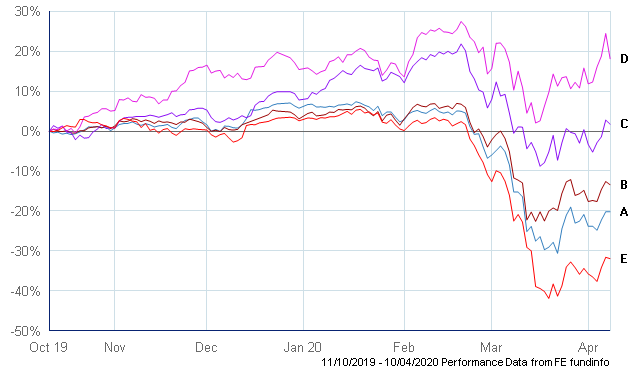
If you look at the chart offered here for download you will see a wide variety of recent returns, although the ‘systemic’ risk shows in all the lines. This is just a sample to make a point
The ‘value’ fund shown (e) – the well known and once much loved M&G Recovery fund has seen a severe loss of value. Biotech and IT company biased funds (d and c) have done much better – no surprise there. The UK and Europe (a and b) and for that matter most global markets only measured geographically have seen similar declines, but here there are differences because of currency and I think because of Covid-19 impact, although I have no evidence to prove that.
So, let’s all buy the most sold off fund? I don’t think so, although that would have worked in the past. We need to think about what will happen to markets in the future, based on what we know now, which is why I have presented the analysis above. The investment world may have been through a permanent change.
Maybe the more expensive (in relative terms) bio-tech stocks are going to be favoured because of rather simplistic decision making by investors feeding into biotech ETFs and other low cost tracker funds. It might be that there is actually no improvement in the success or profitability of the shares making up some bio-tech index but the wall of money that might be heading there will push up prices anyway.
What do you think?
I can’t say that at this moment I know the answer the question posed in the heading, but I know what I am keeping an eye on! I am happy to explore these ideas with readers in more detail if it will help them in their research and asset allocation work.
PS
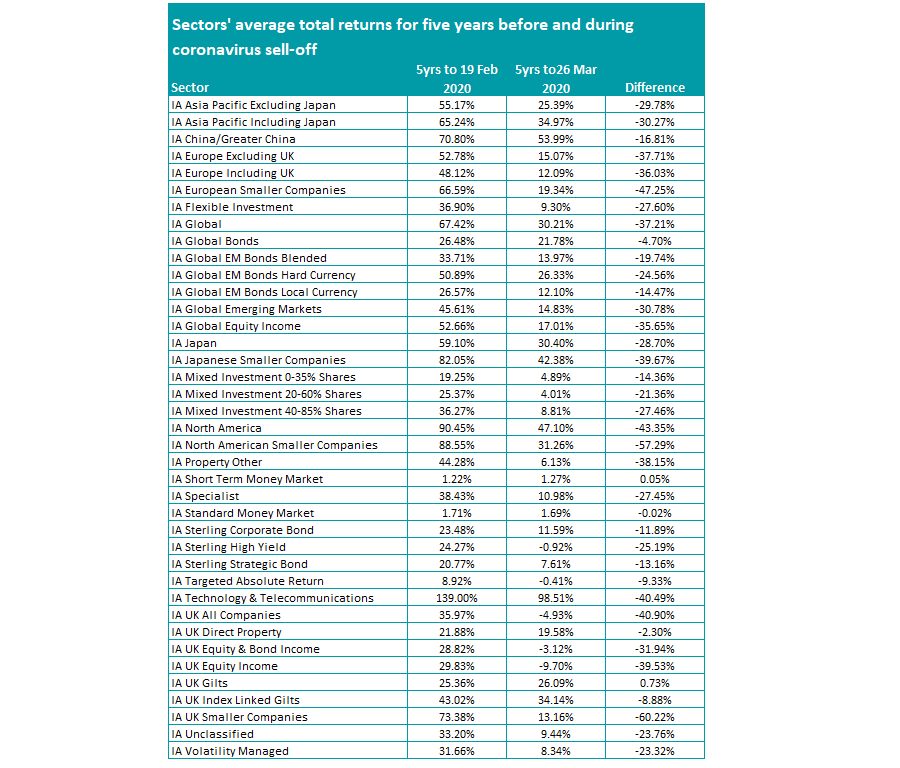
This may be of interest to readers! (Source: Trustnet)
You must be logged in to post a comment.