Some time ago, I noted in passing that the recent returns of the various equity/fixed income mix Vanguard Life Strategy funds had come together in an unusual way. Now we have seen a recovery in most global equity markets, especially in the US where all the funds have a heavy equity weighting, I thought it would be sensible to take another look.
I know that many of my subscribers own these funds and with good reasons – they are a cost effective and transparent way to test out the classic market theory of asset class diversification. But as I explain in more detail in the members only Muti-asset Academy section of the web site, they are not a panacea.
Here is a plot (click on the title to view) of the 80%/60%/40%/20% equity funds in order (the 80% fund is A and so on).
The reversal of the long term performance trend which duly shows the funds with the higher equity content making the most money is obvious in March this year at the peak of the pandemic driven sell off.
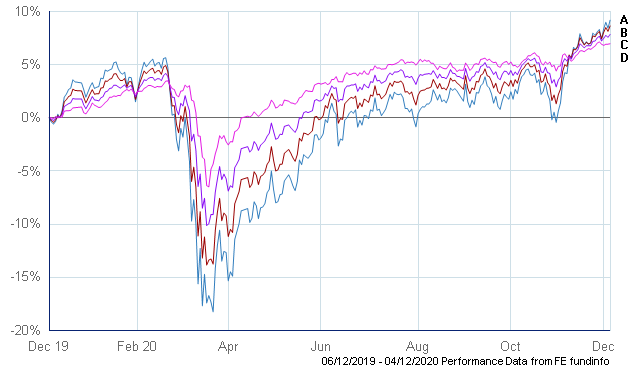
In the period prior to the sell off, the fund at the top of the graph (turquoise line) is the 80% equity fund and at the bottom is the mauve 20% equity fund. This order is neatly and dramatically reversed as the additional volatility of the funds with more equities amplifies the impact of the market taking fright.
This is a textbook example of diversification working as a ‘shock absorber’. If you had invested at the beginning of 2020, you would likely have been a lot less worried in April if you owned the fund with 80% fixed income and probably felt quite smug right through until the Autumn.
But if you really understood that investment is a long term process and having recently invested you correctly decided to ignore completely short term returns, looking at your portfolio only occasionally, you would be happier of you had invested in the 80% equity fund.
My point is not to suggest that diversification is without merit. What I do believe is that although the classic (over 50 years old) theory of using fixed income stocks to diversify risk can be proven to lower volatility, that is only useful during a sell off and if you did not actively trade the asset mix (selling bonds to buy equities at the bottom of the sell off), you gain nothing over the medium to long term.

In truth, owning fixed income stocks in an ultra low interest rate climate adds long term risk and supresses overall returns. Only highly active tactical bond funds with macro themes and short duration make sense to me.
The almost set in stone structure of the Vanguard Life Strategy funds means that the fixed income exposure is not tactical and appears to have far more long dated bonds coming from the fixed income indices than I would be comfortable with. For that reason, I suggest that any reader holding funds with more fixed income than equity takes a careful look at what assets she or he actually owns. That means scrutinising the Morningstar X-Ray analysis and looking carefully at the style data and top 10 holdings.
If owning more equities makes you more money in the long run and owning fixed income stocks at this point in time is arguably riskier than it is allowed to be by historical theory, should you not look for other ways to diversify long term risks, not just look to benefit from a psychological shock absorber? I think that question is worth some of your time.
You must be logged in to post a comment.