Below are charts for the share prices of 3 truly global companies – one is actually the largest company in the world by capitalisation – note the 4.4T valuation! The others are not small at around 200 billion. The first 2 charts are over one year and the last is over 5 years for reasons that will become clear.
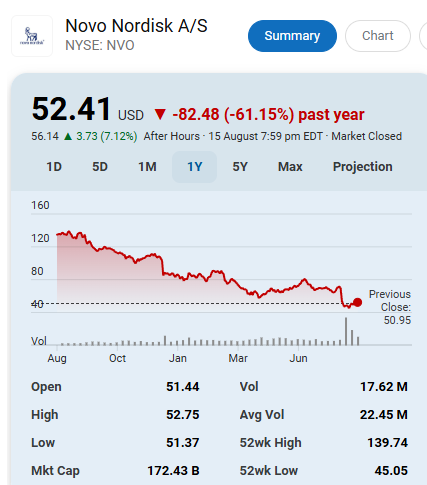
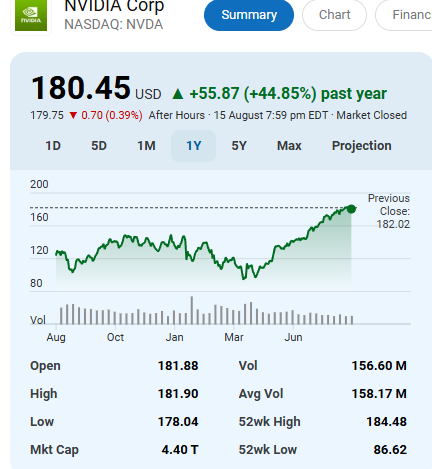
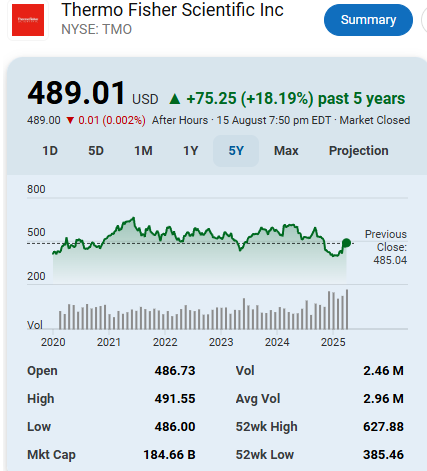
What these charts show is that the short term share price momentum is driven by what the markets thinks is going to drive profits in the future. It is also possible to note that a good business can still make solid returns on average even after a momentum ‘climb’ fizzles out, but that depends on its operations being widely based.
- AI and NVIDIAs relatively strong position at the moment as the main micro processor supplier to the world has driven its share price to fantastic levels.
- NovoNordisk’s share price has fallen dramatically because it is expected (not by all) that its main competitor has developed a more successful weight loss drug and that its (apparently extorionate) US pricing can’t be sustained under Trump.
- The TFS chart shows the story as it often pans out over the long term. It’s not so obvious on the chart but its share price rocketed during the pandemic because it was a major manufacturer of reagents used in Covid-19 test kits as well as other associated medical equipment that was in demand. After falling back, the share price has bumped along and arguably fallen into bargain territory. I bought a small stake a few weeks back.
Which share would you want in your fund? It obviously depends on when you bought the fund. Most of us will have owned all 3 of these shares at some stage in the last 5 years and made money as a result. But did the fund managers we trust sell out before the reversal (or pending reversal in the case of NVIDIA – there will be one!)?
It’s this sort of understanding that is useful: that share prices that fly over a short period are driven by sentiment that gives the lie to the ‘buy and hold’ and nothing else approach. That is unless you are not going to own shares driven by momentum at all (in a a broadly Warren Buffet style). That would mean owning equity income funds in broad terms.
It pays to understand these sorts of valuation patterns when comparing funds and the ‘active’ or claimed long term attitudes of the particular managers.
You must be logged in to post a comment.