• Skip to main content
  • Skip to primary sidebar
  • About This Website
    • A polite reminder
  • How To
    • Use this website and benefit from the subscription option
    • Pick a financial adviser
    • Ensure your investment adviser is delivering good value
    • Get expert help with running your own portfolio
    • Pick a ‘tax wrapper’
    • Pick a Trading Platform
    • Diversify a portfolio in today’s world
    • Invest in line with your conscience
    • Research (screen for) a specific fund requirement (m)
    • Pick a fund for the future or how to be a contrarian (m)
    • Find the ‘next best thing’ and make rational sell decisions (fund switching) (m)
    • Time investment sales (skim profits) (m)
    • Interpret a Morningstar X-Ray (m)
    • Use Trustnet for Research (m)
    • How to review a neglected portfolio when the world has moved on (m)
  • *Important Information*
  • Real World
    • A Frank Introduction to Investing
    • Costs
    • Investment Risk – Your Starter For 10
    • How are advisers fees worked out?
    • 10+ top tips for investors
    • An actual portfolio review (m)
    • Benchmarks – a thorny subject
    • Disinvestment from fossil fuel businesses – are there better options?
  • Tales of the Unexpected
    • Lola
    • Round and Round the Mulberry Bush
    • FOMO (Fear of Missing Out) and the lazy mind.
    • Property Development Schemes
  • For More Experienced Investors
  • Glossary with a Difference
  • Member Only Content (M)
    • Example of simple cash flow planner (m)
    • Long Reads
      • What is market shorting and is it a bad thing?
      • How to conduct a periodic portfolio review (m)
      • Investing without management (passively) – a better way? (m)
  • Portfolios and Funds (m)
    • Lessons in Portfolio Construction and Maintenance – Introduction
      • High Level Asset Allocation
      • Selecting Funds
      • Cash Flow and Tax Issues in Portfolio Construction
      • Setting Objectives and Understanding Risks
      • A suggested portfolio for Alex Bright
  • Multi Asset Academy (m)
    • Some basic basics
    • Who are Vanguard?
    • Are multi-asset funds expensive?
    • Cheap and cheerful?
    • Its all about asset allocation, but…
    • Myth and misunderstandings
    • Taking money out of multi asset funds – the pros and cons
    • Distribution funds – the forerunner of multi asset investing?
    • DIY Multi Asset – adding risk controls
    • Benchmark Fog
  • Member Login
  • Logout

Its Not Harry

Comment and opinion for retail investors in the UK

Monthly commentary

Watching Brief – January 2024

2nd January 2024 by Mark Potter Leave a Comment

Happy New Year!

I promised a look back on 2023 and some pointers on what to look out for in 2024, with just a smattering of predictions for the coming year.  Let’s do it!

2023

I spotted that the FT ran a headline on December 31st along the lines of 2023 being the best year for markets since 2019. As 2020 was something of a special year due to the pandemic and the end of 2021 was the collapse of the long, fantasy driven, free money, bull market, that is not a hugely inspiring claim.  2022 saw the realization that fixed income stocks and growth equity discounts had been based on a wildly optimistic bet that interest rates would stay low for ever, so was an equally gloomy year (but one that many had seen coming).

Forwards into a new dawn?

2023 was in fact at the start very much a continuation of 2022, with an expected recovery in fixed income (bond) valuations deferred longer than many (including me) anticipated as central banks dramatized their heroic role in battling inflation with ‘higher for longer’ interest rates.  It was only in late October that markets collectively decided not to believe that rates were going to stay up much longer and a new, and I think permanent, upward trend in valuations commenced.

If interest rates were the main driver of 2023 markets as a whole, then a whole raft of economic problems in China, or more exactly the very negative perception of Western investors about China as a place to invest, meant that a place where you would have wanted to lower your asset mix exposure in 2023 was China and by implication, many Asia Pacific and Emerging Market funds where the managers were still sticking to heavy fund weightings in the main China and Hong Kong stock markets.

A place where I thought investors ought to be confident bumping up their asset allocations was the unloved UK.  Some funds with careful stock picking have already offered very solid returns from portfolios of mostly UK shares and I think this is just the start of a new phase when global money flows into UK companies with secure profits and ridiculously low P/E ratios.  A recovery in technology shares was kicked off by almost irrational enthusiasm for everything you could stick an AI badge on.

So we have arrived, for better or worse as always at the start of a new year.

You need to be logged in to view the rest of the content. Please Log In. Not a Member? Join Us

Filed Under: Education, Markets, Members Only, Monthly commentary, Portfolios, Trading

Midweek Musings – Seasons Greetings!

20th December 2023 by Mark Potter Leave a Comment

It looks we may be in for a rather late Santa Claus rally in the UK market with better than expected inflation numbers just published.

I was amused to see someone in government or the Bank of England saying that workers would need to accept lower pay rises before the central bank interest rate would come down. With many fixed rate mortgages at low rates coming to an end now, I can imagine many a home owner adopting the mirror position and unions also saying that as long as interest rates remain high, workers need large pay rises!

The sharper than expected drop in inflation without a large rise in umemployment, which is what is also happening in other major economies, further confirms that the bout of infaltion which is now tailing off was driven by supply side factors and central banks are likely to cause uneccesary recessions if they don’t take their foot of the brake and start a little stimulus before long.

Maybe the markets are here with our 2023 presents?

Markets, I suspect, do not believe that the hawks on central banks committees are any more in the majority, so are anticipating rate cuts in 2024. The risk to equities is in fact the aforementioned potential recessions.

Fixed income assets are for that reason useful insurance at the moment – in fact something of a one-way bet.

My January monthly briefing will be the next publication from me, when I will look back briefly on 2023 and do some crystal ball gazing for 2024, like a true Janus.

Until then, I wish all my readers a peaceful, healthy and happy fortnight over the holiday season. And a nice fat portfolio valuation for December 31st!

Filed Under: Economics, Markets, Monthly commentary, Uncategorised

Midweek Musings – New direction?

13th December 2023 by Mark Potter Leave a Comment

As I have repeated ‘ad nauseum’ the likely direction of both equity and fixed income valuations has for many months depended only only one factor: what markets though would be the next central bank move on interest rates.

Different market segments have reacted in slightly different ways, such as short dated bonds doing better than long dated when rate rises were frequent, but really the alleged ‘fight against inflation’ has been the only news you needed to follow.

I think that will change in 2024.

You need to be logged in to view the rest of the content. Please Log In. Not a Member? Join Us

Filed Under: Economics, Markets, Members Only, Monthly commentary

Midweek Musings – no correlation?

6th December 2023 by Mark Potter Leave a Comment

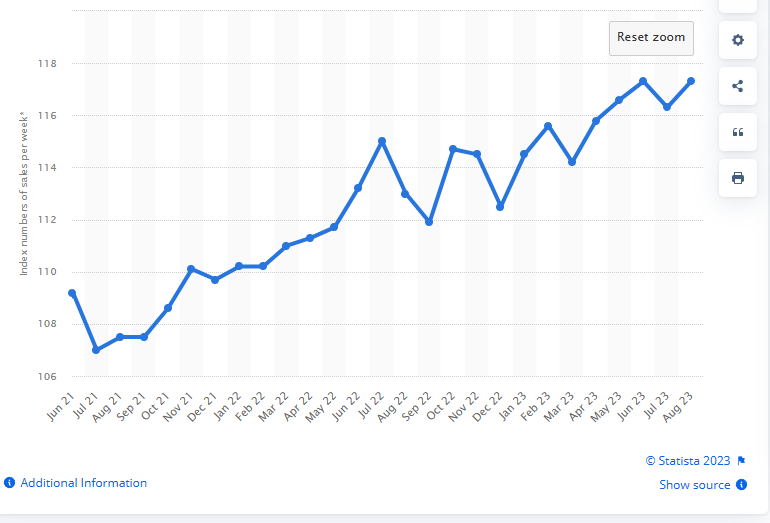
Take a look at this chart:

The above is one measure of retail sales growth in Great Britain (Source: Statista).

You need to be logged in to view the rest of the content. Please Log In. Not a Member? Join Us

Filed Under: Economics, Markets, Members Only, Monthly commentary, Rants

Watching Brief – December 2023

30th November 2023 by Mark Potter Leave a Comment

Pottering About

Last year, I wrote a traditional ‘review of the year’ piece in December.  I am thinking this year that it would be premature, as how December turns out will likely be the way we remember 2023, which has been very bumpy for investors, especially this Autumn.  So, I will likely write about what lessons we can draw from 2023 next month, using my conclusions to take an astrologers look into 2024!

For this post, I will instead draw your attention to a few topics that I hope will be salient and assist you in your portfolio assessments.

You need to be logged in to view the rest of the content. Please Log In. Not a Member? Join Us

Filed Under: Basics, Education, Members Only, Monthly commentary

Midweek musings – How Morninstar upsets the US energy lobby

8th November 2023 by Mark Potter Leave a Comment

As I got positive feedback from my offer to supply summaries of interesting investment webinars that come my way, I am going to try and precis a 50 minute presentation from Morningstar (MS) from a mini-series called “Investing in times of climate change”. There is a full written report with this title that I can access if anyone wants all the details.

As context, I need to point out that the presenation was from MS European and Asian staff, for reasons that will become obvious and the work underlying the report was done by the MS subsidiary Sustainalytics, itself now a ‘bete-noire’ of the US organisations that are influenced by the fossil fuel businesses and anti-sustainablilty lobby – a surprisingly powerful group of people.

You need to believe that there is global warming for this post to be of any use

There was a lot in the presentation and even writing notes for a precis, I had over 20 points, so this is a VERY condensed version.

Main points

In the database covered by Sustainalytics to which they applied their assessment methods (more of which later) not a single business was aligned with the +1.5C climate temperature rise target that is generally linked to the 2015 Paris Agreement.

MS have defined 5 types of portfolio strategy, or labels to attach to a company: Low carbon, Climate Transitions, Green Bonds, Climate Solutions and Clean Energy/Tech. Whilst Green Bonds is obviously a discrete category, the demarcation lines and classification rules for the others were not imediately clear to me from the presentation, but likely would be after reading the report.

Growth in climate focused funds has ballooned over the last 5 years, but this is nearly all in Europe. China now has more money in climate focused funds than the USA!

2021 saw record inflows into climate focused funds and in line with markets overall, they have since declined, but less rapidly than the whole market.

China has a growing but volatile (because heavily influenced by retail investor speculation) market for climate funds partly because of the Chinese government’s, often misreported, strong commitment to zero carbon goals.

Outside of Europe, the USA and China there are only a tiny number of climate focused funds with Australia, Canada, South Korea and Taiwan currently having a handful each. However, this market is growing fast from this low base.

Investors at the moment most prefer the Climate Transitions segment of the 5 categories defined by MS.

Tests by Sustainalytics against carbon emissions deliver better results for the Low Carbon (no surprise there) and Climate Transitions groupings and worse results for Clean Energy/Tech. The latter sector has been the least popular with investors recently but I did not spot any comments about correlation with emissions assessments. More was explained about the mehodology of scoring the companies and groupings later on.

An interesting aside observation supplied was that companies producing clean energy will in many cases still have fossil fuel operations, so as businesses will score badly on emissions measures.

Nobody would argue that we do not have an obligation to look after the planet.

The keystone measure used by Sustanalytics is Implied Temperature Rise (ITR). This is made up of a 2 part measurement/assessment: actual data in the public domain or made available to MS about the firm’s climate policy and actions, and in addition a governance or management quality factor. I would imagine that the latter is likely to be controversial and potentially highly annoying to some firms!

Some stock examples where firms that on the face of it might look good for ESG investors scored very badly using this methodology. L’Oreal was one, apparently because its supplier chain, being of course mostly chemical companies, have very poor scores for emissions. I had never thought that there should be a limitation on the use of make up by eco-warriors, but it seems very appropriate!

When the whole universe of ITR rated stocks was averaged out, the result was +2.5 degrees, so way out of line with the ambitions of the Paris accord. However, understanding the way this data has been derived is not so easy.

The presenter (English) from Sustainalytics showed an example fact sheet that is available to MS subscribers to the appropriate service level (All MS webinars have a sales objective that surfaces towards the end) and explained that their users want a ready made independent assessment of companies’ ambitions on climate related objectives so Sustainalytics has created more than 80 data collection points that are weighted to give a score against a target company’s own published plans and expectations, with the results seeming to show quite wide discrepancies. An element of AI processing is used to generate the resulting graphical outputs.

Observations

I found much of the data about investors’ attitudes to cimate change and carbon emmissions reduction generally encouraging. However, I found that I was thinking along the lines that it is not safe to accept carte blanche an assessment of a company’s suitability for investment based on rather arbitrary classification into one of 5 possibly overlapping groups and an ‘AI’ influenced score based on data that may not even be reliable. I am especially sceptical of over-classification using labels, which is in truth MS’ bread and butter modus operandi. I also am skeptical of MS use of the fashionable ‘AI’ label – I guess they have been using algorithms for years and there is no such thing as an intelligent algorithm!

More work needs to be done

I think it is maybe fair criticism of Sustainalytics by some senior people in US companies and institutions to suggest that they at least appear to be taking a political stance. Of course, the majority of governments, who by definition are taking a political stance, support the Paris accord climate obectives and later ones too, so MS are not on the face of doing work that does not have public consent. What is maybe worrying is that their methodology is proprietary, to a degree a commercial secret and could, in my opinion, generate misleading and unhelpful results in at least some cases.

I personally, as a very politically sensitive person, am all in favour of investors knowing about the real (as opposed to stated for PR purposes) influence on the environment of companies in the funds they own. But I would not be happy if I found the manager was picking stocks with over reliance on computer generated score sheets or databases.

As with many aspects of making sustainable investment choices, we find ourselves being given tools that are along the lines of what we want, but are probably rather less sophisticated than we would like. I feel at times like I would if I was asked to identify a small bird in the tree tops using Lord Nelson’s telescope!

PS Since publishing this piece, I see a headline in the FT – “UK set to unveil plans to regulate ESG rating agencies”. Your scribe is on point!

Filed Under: Monthly commentary, Rants, Research tools, Sustainability/ESG

  • « Go to Previous Page
  • Page 1
  • Interim pages omitted …
  • Page 9
  • Page 10
  • Page 11
  • Page 12
  • Page 13
  • Interim pages omitted …
  • Page 38
  • Go to Next Page »

Primary Sidebar

Recent Posts

  • Mid-month Musings – September 2026
  • Deep Dive – September 2026
  • Mid Month Musings with Mark (not me!)
  • Thank You
  • Deep Dive – August 2026

Archives

Categories

  • Academic theory
  • Announcements
  • Asset Allocation
  • Basics
  • Cost of investing
  • Economics
  • Education
  • Funds
  • House rules
  • Humour
  • Innovation
  • Markets
  • Members Only
  • Monthly commentary
  • News
  • Opinion
  • Passives and Trackers
  • Politics
  • Portfolios
  • Rants
  • Research tools
  • Site Content
  • Sustainability/ESG
  • Trading
  • Uncategorised