• Skip to main content
  • Skip to primary sidebar
  • About This Website
    • A polite reminder
  • How To
    • Use this website and benefit from the subscription option
    • Pick a financial adviser
    • Ensure your investment adviser is delivering good value
    • Get expert help with running your own portfolio
    • Pick a ‘tax wrapper’
    • Pick a Trading Platform
    • Diversify a portfolio in today’s world
    • Invest in line with your conscience
    • Research (screen for) a specific fund requirement (m)
    • Pick a fund for the future or how to be a contrarian (m)
    • Find the ‘next best thing’ and make rational sell decisions (fund switching) (m)
    • Time investment sales (skim profits) (m)
    • Interpret a Morningstar X-Ray (m)
    • Use Trustnet for Research (m)
    • How to review a neglected portfolio when the world has moved on (m)
  • *Important Information*
  • Real World
    • A Frank Introduction to Investing
    • Costs
    • Investment Risk – Your Starter For 10
    • How are advisers fees worked out?
    • 10+ top tips for investors
    • An actual portfolio review (m)
    • Benchmarks – a thorny subject
    • Disinvestment from fossil fuel businesses – are there better options?
  • Tales of the Unexpected
    • Lola
    • Round and Round the Mulberry Bush
    • FOMO (Fear of Missing Out) and the lazy mind.
    • Property Development Schemes
  • For More Experienced Investors
  • Glossary with a Difference
  • Member Only Content (M)
    • Example of simple cash flow planner (m)
    • Long Reads
      • What is market shorting and is it a bad thing?
      • How to conduct a periodic portfolio review (m)
      • Investing without management (passively) – a better way? (m)
  • Portfolios and Funds (m)
    • Lessons in Portfolio Construction and Maintenance – Introduction
      • High Level Asset Allocation
      • Selecting Funds
      • Cash Flow and Tax Issues in Portfolio Construction
      • Setting Objectives and Understanding Risks
      • A suggested portfolio for Alex Bright
  • Multi Asset Academy (m)
    • Some basic basics
    • Who are Vanguard?
    • Are multi-asset funds expensive?
    • Cheap and cheerful?
    • Its all about asset allocation, but…
    • Myth and misunderstandings
    • Taking money out of multi asset funds – the pros and cons
    • Distribution funds – the forerunner of multi asset investing?
    • DIY Multi Asset – adding risk controls
    • Benchmark Fog
  • Member Login
  • Logout

Its Not Harry

Comment and opinion for retail investors in the UK

Mark Potter

Monday mashup – Vanguard Lifestrategy update

7th December 2020 by Mark Potter Leave a Comment

Some time ago, I noted in passing that the recent returns of the various equity/fixed income mix Vanguard Life Strategy funds had come together in an unusual way. Now we have seen a recovery in most global equity markets, especially in the US where all the funds have a heavy equity weighting, I thought it would be sensible to take another look.

I know that many of my subscribers own these funds and with good reasons – they are a cost effective and transparent way to test out the classic market theory of asset class diversification. But as I explain in more detail in the members only Muti-asset Academy section of the web site, they are not a panacea.

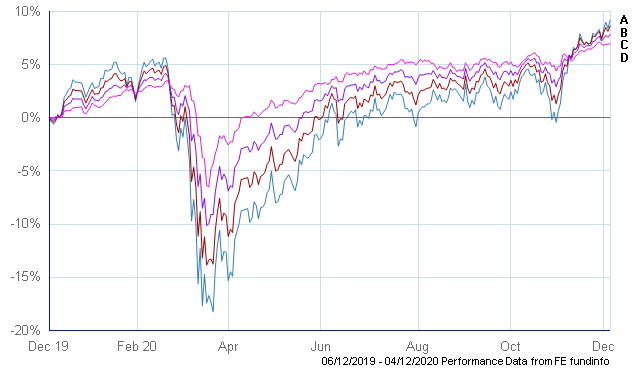
Here is a plot (click on the title to view) of the 80%/60%/40%/20% equity funds in order (the 80% fund is A and so on).

The reversal of the long term performance trend which duly shows the funds with the higher equity content making the most money is obvious in March this year at the peak of the pandemic driven sell off.

Vanguard-Lifestrategy-FundsDownload

In the period prior to the sell off, the fund at the top of the graph (turquoise line) is the 80% equity fund and at the bottom is the mauve 20% equity fund. This order is neatly and dramatically reversed as the additional volatility of the funds with more equities amplifies the impact of the market taking fright.

This is a textbook example of diversification working as a ‘shock absorber’. If you had invested at the beginning of 2020, you would likely have been a lot less worried in April if you owned the fund with 80% fixed income and probably felt quite smug right through until the Autumn.

But if you really understood that investment is a long term process and having recently invested you correctly decided to ignore completely short term returns, looking at your portfolio only occasionally, you would be happier of you had invested in the 80% equity fund.

My point is not to suggest that diversification is without merit. What I do believe is that although the classic (over 50 years old) theory of using fixed income stocks to diversify risk can be proven to lower volatility, that is only useful during a sell off and if you did not actively trade the asset mix (selling bonds to buy equities at the bottom of the sell off), you gain nothing over the medium to long term.

In truth, owning fixed income stocks in an ultra low interest rate climate adds long term risk and supresses overall returns. Only highly active tactical bond funds with macro themes and short duration make sense to me.

The almost set in stone structure of the Vanguard Life Strategy funds means that the fixed income exposure is not tactical and appears to have far more long dated bonds coming from the fixed income indices than I would be comfortable with. For that reason, I suggest that any reader holding funds with more fixed income than equity takes a careful look at what assets she or he actually owns. That means scrutinising the Morningstar X-Ray analysis and looking carefully at the style data and top 10 holdings.

If owning more equities makes you more money in the long run and owning fixed income stocks at this point in time is arguably riskier than it is allowed to be by historical theory, should you not look for other ways to diversify long term risks, not just look to benefit from a psychological shock absorber? I think that question is worth some of your time.


Filed Under: Members Only

Watching Brief – December 2020

1st December 2020 by Mark Potter Leave a Comment

You need to be logged in to view this content. Please Log In. Not a Member? Join Us

Filed Under: Monthly commentary, Uncategorised

Monday mashup – hang on!

30th November 2020 by Mark Potter Leave a Comment

As today is the last day of the month, I will not post my thoughts. They will be integrated in my subscriber only newsletter for December which will be published in the next few days.

Filed Under: Announcements

Monday mashup – the hokey-cokey

23rd November 2020 by Mark Potter Leave a Comment

The title reference is to the ‘in, out, in, out shake it all about’ line in that dance. I am prompted to write about the evergreen conundrum of market timing, mainly as a refresher, for two reasons.

A perpetual question

Firstly, when I am completing the first stage of my training plans with subscribers, they inevitably become nervous when the time comes to actually make purchases from cash reserves. Secondly, the current climate is one where all 3 of the major uncertainties overhanging financial markets for so long are becoming less unpredictable (US elections, Brexit and Covid-19). One might say, one sorted, one soon to be sorted in a way we can predict and the last looking a bit less disastrous.

The second factor suggest it might be a good time to invest but unusually the pricing of large parts of the market suggest there are only 2 games in town: booming new tech growth stocks and dull low value businesses doing old fashioned things. This makes decisions on purchasing far from straightforward without some discipline and methodology.

Resources

I have written on this subject from various viewpoints before. Here are some reference points (several will be subscriber only):

How to time investment sales

Blog post -June 2018

How to pick a fund for the future or how to be a contrarian

A fable for investors

The last article is quite long and I enjoyed writing it, but it may be tricky to follow for some readers. It serves to show that decisions to take money out of markets and re-invest later can be rewarded handsomely but in most cases, the source of the extra profit is luck.

This article can be understood well enough if you skip past my ‘in’ jokes about the financial system in the back story and start reading from the ‘3 decisions’ paragraph.

Some basic common sense

There is good sense in buying obviously cheap markets after a crash and not piling all your free cash into a market that has been booming for years. But aside from those common sense observations, I would suggest the best approach is to think about the long term and have a simple risk minimisation strategy.

Some years ago the then famous fund manager Anthony Bolton (a contrarian manager by style) used to often say that ‘time IN the markets is better than TIMING the markets’. If you look at very long term graphs of stock markets you will see that he is absolutely correct. The line goes steadily up and unless you have a gigantic screen or very large piece of paper, the compression of short term movements means you will not be able to even see the large drop of say October 1987.

Some text book rubrics

Don’t focus on the wrong data – investment is long term

Two things need to always be born in mind:

Every investor, however skilled or experienced buys the right investment at the wrong price when judged over a week or a month, but that might look like a stunning piece of judgement over 5 years or 10 years. In fact, I personally often buy investments I expect to do well a little early and lose money until the market catches up with my analysis. I don’t mind an initial 15% loss if my investment is up 25% in a year’s time – I might have made a lot less if I had waited and the price had already gone up 20% from the low point.

So rule number one it to not get all bitter and regretful about a fall in price in the early weeks or months of a well thought through fund selection.

The second idea to always remember is that when you invest sensibly (ie in diversified and intelligently chosen blocks of shares), you are just jumping on the capitalist machine. It’s function is to make money for investors and over time IT ALWAYS DOES.

Some of us (me included) find the way in which that happens at times rather inconsistent with our personal ethics, but that is really rather irrelevant – the machine exists as a part of the world and without it, the world would not function – even the Chinese communists seem to accept that.

So even if the machine grinds to a halt due to a malfunction from time to time and some people lose faith in it, it gets fixed pretty quickly. One only loses money from a diversified portfolio of collective funds (irrespective of when you bought an investment), if one withdraws money at the wrong time.

So the thing to worry about is managing your cash flow, not when to invest.

If I could ever claim to have been a good IFA, I would like to think it is because I got people to think about objectives first and short term investment returns second. If you have 3 young kids and can only afford one family car, you don’t start your selection process with 0-60 times and top speeds.

We all keep learning

To improve returns, it may arguably make sense to phase investments of larger sums – I accept that. Refer to the various articles listed above for other angles, but don’t expect a neat ‘this is the trick’ answer – it does not exist!

But we can try different techniques and become a little more skilled. We will make mistakes on the way – the world can mess up the most rational decisions. In investment portfolio construction and purchase, the only perfect science is hindsight

Filed Under: Markets, Monthly commentary, Trading, Uncategorised

Nikol-ess?

16th November 2020 by Mark Potter Leave a Comment

The strange title of this post is a cross reference to my post/rant entitled ‘Emporer’s New Clothes’ in June 2020.

This is about Nikola, the start up electic vehicle business into which GM invested a calculated 2 BILLION dollars, according to media reports.

By September 10th a major documented report (67 pages of it) was published by a researcher and market shorter called Hindenburg – look at hindenburgresearch.com – claiming Nikola’s founder Tevor Milton and associates were lying in their teeth. The founder had already built a track record of dubious dealing and misrepresentation and his brother, the named director of hydrogen technology, is reported to be well qualified in pouring concrete and maybe projecting fantasies but not as a hydrogen fuel scientist.

The up and running hydrogen powered trucks for which so many orders were claimed to have been placed (the same orders more than once) were of course fakes. This much had already been suggested by Bloomberg. Nikola’s first effort (in 2016) at a hydrogen truck was actually powered by gas, but CNG, not hydrogen. Natural gas powered buses are of course already in widespread use.

In the chaos that resulted GM appointed a new chairman (the guy who did the investment deal). They are still involved, but with probably not much money or even time really spent and they may have acquired a potential research facility. They probably got good publicity from the coverage of the ‘investment’ and there has not been much general publicity about the Hindeburg report and its consequences.

The quoted 2 billion investment was based on the supposed valuation of the Nikola business, not an actual amount of money spent.

The fuller story presented by Hindenburg is an entertaining story by itself if you are interested in the not uncommon blatant corporate deceit that pops up in the US in particular but also in the UK; those of you with Hampshire connections may recall a major IT con being perpetrated on the Wessex Regional Health Authority by a newly formed business.

The nugget of human behaviour that I collected from this tale was the willingness of people who should know better to take as fact presentations that are quite plainly suspicious or even obvious lies. They do this because they are ‘primed’ to do so and to act sceptical would risk opprobrium from their fellow humans.

Much as the Andersen tale warns. Good sense has always been around if you looked for it. Companies that never make profits and maybe not even any products are NOT worth a cent in reality. But plenty of money may get made trading their shares on fantasy valuations before the small child (or market shorting specialist) blurts out the truth.

Filed Under: Rants

Monday mashup – let’s go to the gym

16th November 2020 by Mark Potter Leave a Comment

The headline is not referring to those strange smelling places where people go to listen to music whilst undergoing a physical regime to better their body and mind. Most of my subscribers are past the age where that would be a tempting way of whiling away their retirement and the younger readers will be locked out anyway, at least for now.

I am suggesting some mental stretches and heavy lifting by the ‘little grey cells’.

The huge banking and asset management business J P Morgan publishes an excellent quarterly information resource and commentary called Guide to the Markets. Anyone can view the main content and J P Morgan even supply helpful viewing tools. Just search for J P Morgan Guide to the Markets using your favoured search engine (Ecosia is worth a try if you are fed up with Google monopolising the world and like the idea your searches funding tree planting to help the NHS).

This drawing depicts a slim and active fellow. From the neck up, it does resemble the author!

There is a vast amount of material available if you want a really testing workout but if your brain has almost hibernated because of lockdowns, scroll down and look at Investment Outlook (under More Insights – in the middle). After an introduction, this has a section called Key Themes.

One article that will be of interest to investors who prefer multi asset funds is the one headed ’60:40 When bond yields are near zero’. Like much of the site content, the commentary is backed by data charts and introduces ideas without getting too complex.

There are many ways of viewing data and commentary – just like a great health club, this place has huge variety of ways of getting your workout.

The forward looking analysis that features in different ways in the data packs and articles was picked up and summarised by media outlets that I saw as suggesting that it was time to look to ‘value’ investing because the growth and momentum factors were going to run out of steam. Assiduous readers of my rambling will know that I have come around to that point of view over the last few months.

My main take from the data is that the ‘on-off’ recession we are seeing now is not like any other and deeper and faster than any in the records but that the trend in US equity valuations is more or less uninterrupted. That suggests a tension that needs to be resolved. If you keep driving your sports car hard with an oil leak and ignore the engine warning light, you will not slow down for a while but the end result will be a catastrophic engine failure.

I like one banner that I spotted on the J P Morgan site: ‘Embrace volatility. Don’t panic. Stay diversified’. Spot on! Even markets that crash offer investors opportunities, if they are prepared.

Personal contact level subscribers who would be interested in exercising their minds by working through some of the resources on offer from J P Morgan can book a ‘personal trainer’ session with me for 45 minutes or so.

Filed Under: Monthly commentary

  • « Go to Previous Page
  • Page 1
  • Interim pages omitted …
  • Page 52
  • Page 53
  • Page 54
  • Page 55
  • Page 56
  • Interim pages omitted …
  • Page 97
  • Go to Next Page »

Primary Sidebar

Recent Posts

  • Deep Dive – November 2026 (Part 2)
  • Deep Dive – November 2026 (Part 1)
  • A little foresight?
  • Mid-Month Musings – Snippets
  • Deep Dive – October 2026

Archives

Categories

  • Academic theory
  • Announcements
  • Asset Allocation
  • Basics
  • Cost of investing
  • Economics
  • Education
  • Funds
  • House rules
  • Humour
  • Innovation
  • Markets
  • Members Only
  • Monthly commentary
  • News
  • Opinion
  • Passives and Trackers
  • Politics
  • Portfolios
  • Rants
  • Research tools
  • Site Content
  • Sustainability/ESG
  • Trading
  • Uncategorised