• Skip to main content
  • Skip to primary sidebar
  • About This Website
    • A polite reminder
  • How To
    • Use this website and benefit from the subscription option
    • Pick a financial adviser
    • Ensure your investment adviser is delivering good value
    • Get expert help with running your own portfolio
    • Pick a ‘tax wrapper’
    • Pick a Trading Platform
    • Diversify a portfolio in today’s world
    • Invest in line with your conscience
    • Research (screen for) a specific fund requirement (m)
    • Pick a fund for the future or how to be a contrarian (m)
    • Find the ‘next best thing’ and make rational sell decisions (fund switching) (m)
    • Time investment sales (skim profits) (m)
    • Interpret a Morningstar X-Ray (m)
    • Use Trustnet for Research (m)
    • How to review a neglected portfolio when the world has moved on (m)
  • *Important Information*
  • Real World
    • A Frank Introduction to Investing
    • Costs
    • Investment Risk – Your Starter For 10
    • How are advisers fees worked out?
    • 10+ top tips for investors
    • An actual portfolio review (m)
    • Benchmarks – a thorny subject
    • Disinvestment from fossil fuel businesses – are there better options?
  • Tales of the Unexpected
    • Lola
    • Round and Round the Mulberry Bush
    • FOMO (Fear of Missing Out) and the lazy mind.
    • Property Development Schemes
  • For More Experienced Investors
  • Glossary with a Difference
  • Member Only Content (M)
    • Example of simple cash flow planner (m)
    • Long Reads
      • What is market shorting and is it a bad thing?
      • How to conduct a periodic portfolio review (m)
      • Investing without management (passively) – a better way? (m)
  • Portfolios and Funds (m)
    • Lessons in Portfolio Construction and Maintenance – Introduction
      • High Level Asset Allocation
      • Selecting Funds
      • Cash Flow and Tax Issues in Portfolio Construction
      • Setting Objectives and Understanding Risks
      • A suggested portfolio for Alex Bright
  • Multi Asset Academy (m)
    • Some basic basics
    • Who are Vanguard?
    • Are multi-asset funds expensive?
    • Cheap and cheerful?
    • Its all about asset allocation, but…
    • Myth and misunderstandings
    • Taking money out of multi asset funds – the pros and cons
    • Distribution funds – the forerunner of multi asset investing?
    • DIY Multi Asset – adding risk controls
    • Benchmark Fog
  • Member Login
  • Logout

Its Not Harry

Comment and opinion for retail investors in the UK

Markets

The Great Depression of the ’20s?

29th April 2020 by Mark Potter Leave a Comment

That means this century, not the 1920s, according to Professor Nouriel Roubini. He is sometimes described as ‘Dr Doom”, although he is not the first commentator to earn that title.

Here is a link to his latest comments as published in The Guardian newspaper:

https://www.theguardian.com/business/2020/apr/29/ten-reasons-why-greater-depression-for-the-2020s-is-inevitable-covid?CMP=Share_AndroidApp_Email

What he says is evidence based and he is a professor at a top university in the US, so I am not going to dismiss his projections, although many people will: they are too unpleasant to contemplate. When the ancient Israelites heard Jeremiah’s projections, they decided it best to keep him out of sight underground and for 40 years, we are told, that seemed to have been a good call. No-one likes a sour-puss. But the story ends with a nation being wipe out.

But equally, I know that projecting the future based on what we know has happened in the past can be unreliable, so one might take a more positive view without being accused of ostrich like optimism.

However, investors need to remember that as recently as 20 years ago, we had awful stock market conditions for over 2 years (2000-2002) when a recession came on the heels of a stock market crash and markets fell back badly after a solid looking initial recovery.

I repeat my current mantra: buying equities has to be a very careful process at the moment and I for one am doing all I can to hedge out the risks of a serious recession. As I explained in my post yesterday (Monday mashup), the valuation of many shares is not currently based on an assessment of quality and likely dividend earnings, but in time, I believe reality will return to take control of market valuations.


Filed Under: Economics, Markets

Monday mashup – a riddle solved?

27th April 2020 by Mark Potter Leave a Comment

This is a long and quite complicated post but I suggest it offers an insight into market pricing that is both a permanent change and relevant to all investors.

The conundrum

As I have suggested in earlier posts, the pricing of global stock markets in the near term will react to news flow about the Covid-19 pandemic, but the medical news flow, not the economics. That follows the fairly unremarkable idea that the economic news probably depends on the medical news.

However, some apparently inconsistent things are happening. For example, when it was suggested that a certain anti-viral drug might be useful, markets shot up on the news but when it was reported that testing was a failure, markets did not fall back.

Furthermore, as the Financial Times noted last week, experienced investors are rather surprised that as time passes and the already known consequences of lock downs are understood, and they are indeed awful for global economies and fatal for some businesses, markets are moving up as if they were pricing for a recovery.

Puzzling

Free money (for now)

Worldwide, governments are inverting the old idea of ‘jam tomorrow’, and instead seeking to keep economic growth going with barrowloads of money, which they are borrowing with no idea of when they will pay it back.

This perhaps harks back to the success of Roosevelt’s New Deal (much hated by corporate American initially, because it was vaguely like communism in their view) but this time the corporates are tuned in and know how to get their grubby mitts on the money before it filters down to all those annoying little small businesses and heaven forbid, actual citizens!

As I will propose later, the price of many large capitalisation shares in the markets is now driven not by value measures but by the trading manipulations of a small number of private individuals, private equity funds and venture capitalists. They learned a while ago how to use the borrowing capacity of major governments to pump the valuations of loss making companies, so when they see the taps of state funding fully open, they see opportunity.

Money like water, finds a level. With more money, the level will be higher.

Now I guess readers may be either feeling lost at this stage, or thinking I am an idiot with a personal political agenda. How does money paid to keep companies and small businesses afloat end up benefiting private equity funds, you may ask.

I will answer that in two stages. Stage one offers a simple explanation of monetary theory, stage two seeks to explain where we are now.

Money makes the world go round.

Money supply and inflation

It is necessary to think about the economic theory of the money supply a little – not too deeply, have no fear!

When the economy is working normally, money is its lubricant. A company raises money from those that already have some (capitalists) and borrows from banks. The money gets used to buy land and premises, investment capital equipment (machines, stock, media content and so on) and to pay people.

All the people who get money from selling things to the company, or working for it, then spend the money on the products and services on offer from all companies. They also pay taxes, in return for which the government delivers services, re-spending the money. They might save some money, but that is not good for most capitalists (some banks excepted), so a massive services industry (marketing and advertising) exists to drive people to consume, based on behavioural psychology.

As long as people and governments spend enough, companies make profits from selling them stuff and they reward the owners of the shares (who may or may not now be the original capitalists) with dividends. If dividends are good, share prices go up because people want to get hold of them.

Sorry, but a bit of theory…

That is the traditional model and it is suggested that it gets rather messed up when governments and consumers borrow money over and above what is generated as explained. A strong view was put forward in the Reagan/Thatcher years that increasing the supply of money by government borrowing would cause inflation. In fact, it might be the main cause of inflation, so they said.

So, if that is the case, we ought to expect inflation in bucket loads in the near future, governments have started borrowing money like the novelist’s miscreant heir to a Victorian fortune.

What gets inflated

When Milton Friedman and his fellow monetarists were advising Mrs Thatcher and Mr Reagan, they were talking about consumer price inflation and wage inflation. It is assumed that workers demand more wages to cover higher prices in the shops. To the capitalists of the USA in particular, wage inflation has been something to control at all costs for well over a century. Even with increased productivity, the biggest risk to profits has always been an increasing wage bill.

But if governments were going to be foolish enough to allow trade unions to operate legally, increases in productivity were likely going to be offset by higher wages. More mechanisation and the use of immigrant labour would help, but in the meantime the easy answer was to keep up the marketing pressure and put prices up. In that way businesses could cope with wage inflation as long as they could put prices up. That was how it was in the 1980’s – you may remember it! Even a left wing Labour government decided the answer was to cap wages.

The monetarists suggested that cutting government activity in the economy would slow down the rate at which money got cycled around (cutting corporate activity could never be on the agenda in the USA). That was taken very seriously as a proposition. Hindsight suggests that it is likely that various other political actions and the rise of technology did more to bring inflation under control, with harsh impacts on traditional industries.

Furthermore, in Japan, where the government has for many years been shovelling money at the economy to generate inflation, it has failed.

So if large increases in the money supply do not seem to result in wage or consumer price inflation, where des the money go? The evidence I think is overwhelming that it goes into financial assets. I think I am late coming to this conclusion and markets are behaving in full expectation of that consequence.

But hang on Harry…

I know, I am always droning on about the value of a share being the discounted value of all future cash flows, being dividends in the main. In other words shares are worth money based on company profits, right? So how can the money coming from government borrowing end up in companies? What’s the link?

Firstly, the extra money in the system will be stored in large part in banks, so they want to lend it. With more supply, interest rates will be lower. The governments also want interest rates to be lower, so they can afford the interest on all those extra Treasuries and Gilts. Lower borrowing costs mean better profits, so potentially higher dividends.

Secondly, if companies can borrow this government dosh very cheaply (even if they don’t need it, as we have just seen in the USA), they can use it to buy back shares.

Thirdly, if private equity firms (and there are many of them controlling trillions in assets), operating through their investments in trading companies that can access this money can get hold of lots of it, and there is evidence that they will, then they can use it for investment activities of all sorts.

Which brings us neatly to the relatively new phenomenon of ‘imaginary’ share valuations.

How to make the value of shares you own go up

The value of ‘quality’ shares is easy to explain. The company has a strong position in various markets, good governance, is technologically advanced, develops new product lines, controls costs etc etc. Investing in such companies will make you money, even it is only decent dividends. But slowly. You may admire Warren Buffet if you think that is the right way to invest.

Are you a long term investor who relaxes and waits for everything to be ok?

That is not the way most 21st Century investors like to play the game. As students, they read about the asset strippers of the late 20th Century, the rise and fall of the dot.com businesses, bank rescues in 2008 and the fortunes made (and lost) in mergers and acquisitions.

This is not really a new idea but they think that the way to make money fast is not to do with investing in great companies – that is for simpletons – it is about knowing how to play the market game, Monopoly on steroids, if you like.

These gamers are now significant influencers of share prices (to include two modern words in one sentence!)

This newest trick is based on funding the ‘next great idea’. That is facilitated by the reality of our living in an age of great change.

It works like this: a company is developed with a workable leading edge technology or new way of meeting a consumer need that can be expanded. I can think of these recent examples: cheap ways of sharing rides (Uber/Lyft), take-away food from your favourite restaurant (Deliveroo), new video content to watch with your slowly congealing nouvelle cuisine (Netflix), an electronic only multi currency bank account (Resolut) to pay for the apartment in Cannes where you going (hopefully) to get real food (AirBNB), wearing the clothes you bought from a new version of John Moores/Littlewoods (Asos/Boohoo) and so on.

Not all great new ideas are that great or that new.

The ‘great new idea’ company needs to scale up, so it gets some private equity firms to take up new shares (a placing) at a modest price – they can see the potential, not just in the business, but in the game of raising money.

The company quickly burns through the capital raised acquiring customers and developing products and services. It makes gigantic losses in accounting terms. Everyone seems strangely happy. Especially marketing services companies.

When it needs new capital, it offers more new shares – the ‘funding round’. By agreeing to buy these at a much higher price, the original club of investors automatically gets their initial investment revalued up and it also puts momentum behind the share price as other investors want to jump on the bandwagon – they know how this game works. Pump, pump.

In some cases the company becomes hugely profitable, but that is not important to the financiers who propelled its share price along – they will sell out quietly at a good profit and if all goes wrong and losses become unmanageable and the company becomes insolvent, they will buy it back again at a gigantic discount.

Does that sound fanciful or immoral? Sorry, dear reader it happens all the time.

  • Potter, you are moralising and still not getting to the point, I fear you are thinking.

The point is this: the money that private equity firms use to fund these transactions is very often borrowed, often in very complex ways.

The more money in the market there is to borrow (see above), the easier it is to drive share prices along like this.

Good value companies may well remain out of fashion and see little share price growth, but shares in ‘next best thing’ companies that offer low or no dividends will mysteriously fly along as each ‘funding round’ goes through.

In effect, capital raising that looks like the issue of equity shares is more like the issue of bonds, in the form of borrowing from banks (and at the moment governments). It is just that a shape shifter, the private equity operator, has come in the middle.

The buyers of the newly issued shares shares have borrowed the money very cheaply and intend to use that money not to bet on the company, but to bet on the market mechanism. If you look through it all, you see that the likes of Tesla are not generally burning through the private wealth of the world’s super rich, but through borrowed money (and some money supplied by retail investors!). That means that people who own Tesla shares are in reality owning junk bonds but with no yield and no maturity date.

But that’s like a Ponzi scheme, surely?

In my view it works much the same, yes. Just like a Ponzi scheme, it works for a while. If you know it’s a sort of Ponzi scheme because you are a relative or a mate of the operator, it’s brilliant! You watch your investment fly and then you exit at a great price.

Of course, eventually the fiction unravels and a lot of less well informed people will lose their shirts.

Summary and conclusion

  • I have proposed that markets are doing much better than economic fundamentals suggest they ought to because experienced operators with billions to invest anticipate that huge flows of cheap to borrow money will allow share prices to get pumped up.

They accept that many companies will reduce dividends, sell up, even go bust, but they see plenty of money to be made just betting on the money levelling up, mainly in the asset valuation ‘slice’ of global wealth.

  • I have further proposed that for some time some asset prices are in fact invented, but sustained as long as new capital can be raised by what appears to be share issues but is actually more akin to junk bonds.

How do we deal with this?

Some investment managers either don’t agree with my expectation that we are heading for trouble with a whole bunch of share values, or they think they can play the momentum for now. This is a reflection of the trend towards ‘factor’ investing.

I personally prefer to avoid those fund managers, so don’t buy funds that are keen on IPOs (new share issues) and loss making businesses. I prefer funds that look at global themes and select profitable companies with cash flow and dividends that can benefit from the way those themes play out.

But have no doubt, the speculators are in charge at the moment. When their fictions blow up, we may have a market crisis bigger than the one we have just seen and even well run funds will carry the systemic market risk. But quality companies are only out of fashion for a while.

I remain of the opinion that overall market levels being so far detached from the returns on traditional good value shares means we have trouble ahead and am thinking very carefully about what to buy to make money long term and control risk short term.

Those of you who prefer index tracking funds need to make sure you are getting an asset mix that does not leave you too exposed to the eventual demise of the ‘momentum’ factor in the market.

Filed Under: Economics, Markets, Politics, Uncategorised

Disconnect? V, U W, L or X(tinction)?

15th April 2020 by Mark Potter Leave a Comment

I suspect you, dear reader, are as bemused as I am that the US stock markets and to a lesser extent those in Europe continue to rise while your preferred source of global and UK news is, I am sure, telling you that the financial implications of the Covid-19 pandemic are disastrous beyond living experience.

There is much talk of the shape of a recovery, both in markets and economies and the shape of that recovery (or non-recovery). The letters above, apart from X which is my addition, are meant to suggest the graph that we will eventually look back on in a while.

I also note that the price of gold continues to rise and in general terms the US dollar is declining in relative terms. So some people are reacting to the situation with a judgement that all is far from well in the USA.

Wall Street or Threadneedle Street – who is right?

I can offer a couple of ideas about this apparent paradox:

Firstly, it is all about Trump. It is reported widely in US news media that the President is getting all his advice from his mates who are business magnates from Wall Street and of course his personal applause machine is working flat out – Fox News and their affiliates.

They think they have him under control (as I wildly speculate does perhaps Mr Putin?). That means that they expect the US economy to kick off again soon and from the current lowish valuation base, there will be money to be made in stock trading.

Secondly, it is suggested that the businesses most hurt by the pandemic don’t make up much of the stock market in capitalisation terms anyway. With some businesses actually making more money (as happens in wars), the net impact on total profits will not be so bad and with the option to short the shares of the struggling businesses – hey, you make money both ways!

This suggests that US capitalism is cynical and amoral in the extreme. It always has been, so no surprise there.

However, it appears that people adopting that line of thinking are hiding their other vices from public view. Modern capitalism is an addict of that Class A drug, consumerism: have no doubt about that. If consumers are financially wiped out, even businesses that can sell stuff without people leaving home are going to see major downturns.

There is an obvious dislocation of opinion between Wall Street (and those that hang on to its coat tails) and the economists and bankers of the world.

We will see who prevails before long. I am not personally risking any bets on the robber barons of Wall Street getting their way this time.

Filed Under: Education, Markets

Monday mashup – a quiet Easter?

13th April 2020 by Mark Potter Leave a Comment

If you are like me, you will have spent Easter mostly at home with maybe a short trip or two to the supermarket or a walk or bike ride, (with a mask on?) for permitted exercise. In the meantime, stock markets have been closed and the tone of the news about the pandemic has taken a distinct turn towards looking for the end of lockdowns (at least in parts of Europe) and ‘exit strategies’.

Of the latter, I suspect there are few that are complete and unsurprisingly much is I think being made up as we go along.

It’s all going to be fine … (said Donald?)

It was clear over the course of last week that investors in enough numbers to generate a sharp jump up in prices were reading the news of a slow down in virus case number growth (in the European hotspots) as heralding the end of the crisis.

The sun is coming out from the clouds and we will soon be back to ever rising stock markets…or will we?

Either that or they just think that the money being thrown at the problem by global powers is going to feed through to company profits without so much as a trading statement on the way!

I have some problems believing that this turn around is based on solid foundations.

A Spanish government minister was quoting as saying that ‘the fire is coming under control’. That is good news but it does not mean that the fire is still not slowly burning away causing continuous economic destruction, never mind the human cost.

My recall of images of places after fires have been brought under control is of burnt out buildings, black vestiges of landscape and car shells on ther way to the scrap yard.

What seems to be working

This link will I hope work for most readers

https://aatishb.com/covidtrends/?location=Lithuania&location=Netherlands&location=South+Korea&location=Sweden&location=Taiwan

The graph shows the rate of growth in new Covid-19 cases in several countries. I have omitted the US and UK because the lines are virtually straight (ie no improvement). You can play with the data, adding or removing countries as you wish.

The countries that knew how to deal with a virus because they had experience of SARS have got the situation under control quickly, with minimum economic damage. Lithuania, the country where I live, being small and able to more easily enforce and monitor a lockdown policy has also started to get improving results – the graph for New Zealand is almost identical. Other countries that made quick decisions on testing and contact tracing are doing well

The lines for Sweden and the Netherlands are added because they took a more liberal view and did not impose lockdowns. Yet. I see that as evidence that they made the wrong calls. Having very socially liberal democracies is like a democratic management style in business, not so good in a crisis.

I provide this data as a useable set because I conclude from a much bigger set of information that the virus is coming under control in some places but will not come under control in countries that are not serious about taking the right measures, be they lockdowns, testing and contact tracing and so on.

Note that I make no comment about vaccinations and effective treatments because in spite of extensive reading, I find nothing to suggest either are round the corner. I also recognise that the virus may be seasonal, if we are lucky.

This line of thinking leaves me extremely concerned about the progress of the disease in the USA, by far the largest stock market in the world and a major source of investor wealth over many decades.

A new driver for markets

There is a new way of looking at stock market direction that takes account of the massive flows into passive or index tracking funds over recent years. There was a fear that such funds might struggle to remain ‘liquid’ in a severe market correction, but so far that difficulty has not happened. Some have become dislocated in pricing terms from the indices they were supposed to be tracking, but this has only been temporary.

Of course, a simple tracker will have been exposed to the full volatility of the index it is tracking and may have lost more money than a managed fund covering that range of shares or bonds. But the multi asset passive funds have generally lost only a little more than managed funds in their peer group and still retain their long term performance advantage, partly a consequence of their low fees.

As passive fund investing has become more sophisticated, I have come around to seeing it as a useful option in the investor’s toolkit.

It seems to me that nothing that has happened over the last few weeks is going to permanently dent the enthusiasm of investors for this sort of investment product and that has consequences for the trading patterns of the markets.

If there are huge sums in funds run by computer algorithms, that money is bound to follow market changes (because the algorithms are programmed to do that).

If for example, traders who are still making decisions place enough orders for Apple shares to push the price up a bit, vast sums of money will potentially flow into Apple shares from passive fund algorithms looking to rebalance their asset mixes, or set up to react to ‘trigger’ information.

It is not possible to easily work out the precise impact of the passive funds – it seems to me to be the sort of subject someone might get a Nobel prize for – but there are many commentators who believe it is a significant contributor to market direction. It may add to volatility. It certainly makes ‘momentum’ a factor to allow for in making decisions.

What is perhaps most worrying is that it looks like passive investing could be the trend that destroys ‘value’ investing. If no-one really sees a case for valuing companies on the potential future growth of profits and dividends from a good value (ie cheap) base point, then all sorts of classic investment models will fail.

If you want to re-invest, where to look?

Funds-examples-0420Download

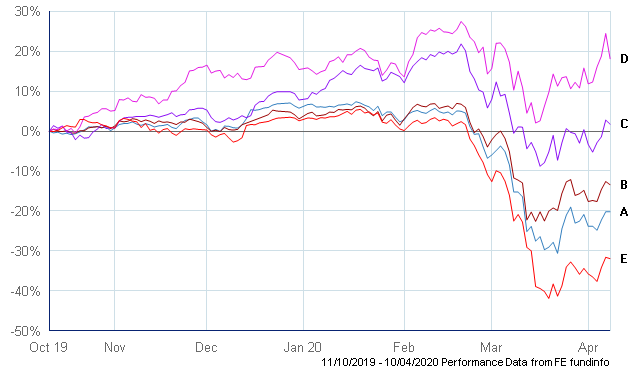
If you look at the chart offered here for download you will see a wide variety of recent returns, although the ‘systemic’ risk shows in all the lines. This is just a sample to make a point

The ‘value’ fund shown (e) – the well known and once much loved M&G Recovery fund has seen a severe loss of value. Biotech and IT company biased funds (d and c) have done much better – no surprise there. The UK and Europe (a and b) and for that matter most global markets only measured geographically have seen similar declines, but here there are differences because of currency and I think because of Covid-19 impact, although I have no evidence to prove that.

So, let’s all buy the most sold off fund? I don’t think so, although that would have worked in the past. We need to think about what will happen to markets in the future, based on what we know now, which is why I have presented the analysis above. The investment world may have been through a permanent change.

Maybe the more expensive (in relative terms) bio-tech stocks are going to be favoured because of rather simplistic decision making by investors feeding into biotech ETFs and other low cost tracker funds. It might be that there is actually no improvement in the success or profitability of the shares making up some bio-tech index but the wall of money that might be heading there will push up prices anyway.

What do you think?

I can’t say that at this moment I know the answer the question posed in the heading, but I know what I am keeping an eye on! I am happy to explore these ideas with readers in more detail if it will help them in their research and asset allocation work.

PS

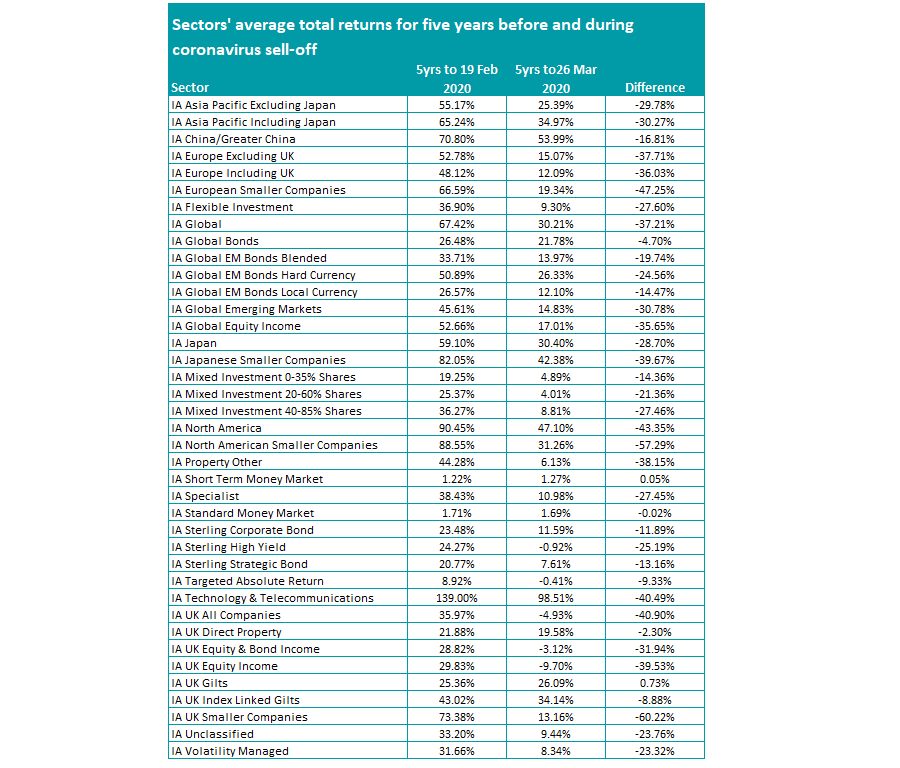
20200330_top_to_bottom_coronavirus_2Download

This may be of interest to readers! (Source: Trustnet)

Filed Under: Education, Markets, Portfolios

Monday Mashup – ps

6th April 2020 by Mark Potter Leave a Comment

One of NotHarry’s readers responded to my comments this morning by asking how one might actually get some objective data on the progress of the fight back against Covid-19. Flippantly, I replied Dr Google.

Googling something like “Coronavirus treatment research” and skipping any advert style listing and the quack medicine entries (so getting to the second or third screen usually) really does work. I can see articles for The Lancet, New York Times, CNN and various science publications even on the first page. Clearly at this time, the most recent articles will likely be the most useful.

Varying the search term to read “scientific articles etc” will get a better list but you won’t be able to read more than a summary or abstract from some of the professional publisher sites.

NotHarry is a true bookworm, both traditional and electronic…

Another useful way to see what is happing is to look at graphics that show the pace of virus spread. I like the tool offered at this web address (URL) https://aatishb.com/covidtrends/. You can easily edit the list of countries whose data is shown. If you did that today and included Austria, you would immediately see why they are able to slightly relax their lockdown. You will also see why there is a lot of pain still to come, if you add the lines for the US and the UK.

Markets today have jumped at the news from Austria and less dramatic improvements in Spain and Italy, but that may be premature, in my judgement.

If you think I am too pessimistic (and I may be, of course), I suggest you might be prudent to make some modest phased allocations of cash to the markets most sold off and those best insulated from the damage already done. To me that suggests a look at the technology and innovations funds and funds investing away from the mega caps (like the FTSE 100). A passive index tracking fund with low costs might well be a simple way to dip your toe back in the water!

Filed Under: Markets, Trading

Monday mashup – what next?

6th April 2020 by Mark Potter 2 Comments

Having published a pretty gloomy synopsis at the start of the month, but also pointed out that the world is changing very fast at the moment, I think I ought to offer some pointers to prepare readers for actions when they feel the opportunity to buy back into global stock markets has arrived.

Do bear in mind that there will not be a single point in time that is the right time to buy – there will be a change in the general trajectory of the valuation graph but it will still be bumpy. Even when there is a so called ‘v’ shaped recovery, the point at the bottom of the ‘v’ may not be that sharp when looked at microscopically.

It is already clear that we are not going to get a ‘v’ shaped recovery this time. If we are lucky enough to get a ‘u’ shaped graph to look back on later, then at the moment we are travelling along the rough bottom of the ‘u’. I am inclined to think we will more likely get a ‘w’ – in other words there is another down leg to come before there can be confidence enough for a permanent climb in valuations.

What will be the advance signs – so called leading indicators – of a recovery?

Bring me sunshine?

In the short term they will all be medical: news of a reliable vaccination; treatment methods (more significant in my opinion); a change in the rate of infection in Europe, the UK and the US; relaxing of lock down measures and so on.

For there to be a quality recovery, rather than just a ‘bear market rally’ the economic prognostications must switch from the absolutely dire (as now) to the ‘not so bad as we feared’.

In the short term, news of major bankruptcies, dividend cuts or even cessation, nationalisations and so on look pretty likely to me. But that may not immediately result in a sharp sell off, more likely a more gradual decline into depression.

As the market is continuing to be to some extent in denial, I suspect that we have some time to go until we reach the final ‘capitulation’ phase. But in this case, the economic news (or at least projections) will I suspect get better after the medical news gets better and markets are well known to be anticipatory.

So I recommend reading all you can manage about progress with the research and science. Understanding when that is about to yield useful results will give you your ‘leading indicator’

Filed Under: Markets, Portfolios, Trading, Uncategorised

  • « Go to Previous Page
  • Page 1
  • Interim pages omitted …
  • Page 23
  • Page 24
  • Page 25
  • Page 26
  • Page 27
  • Interim pages omitted …
  • Page 36
  • Go to Next Page »

Primary Sidebar

Recent Posts

  • Mid-month Musings – September 2026
  • Deep Dive – September 2026
  • Mid Month Musings with Mark (not me!)
  • Thank You
  • Deep Dive – August 2026

Archives

Categories

  • Academic theory
  • Announcements
  • Asset Allocation
  • Basics
  • Cost of investing
  • Economics
  • Education
  • Funds
  • House rules
  • Humour
  • Innovation
  • Markets
  • Members Only
  • Monthly commentary
  • News
  • Opinion
  • Passives and Trackers
  • Politics
  • Portfolios
  • Rants
  • Research tools
  • Site Content
  • Sustainability/ESG
  • Trading
  • Uncategorised